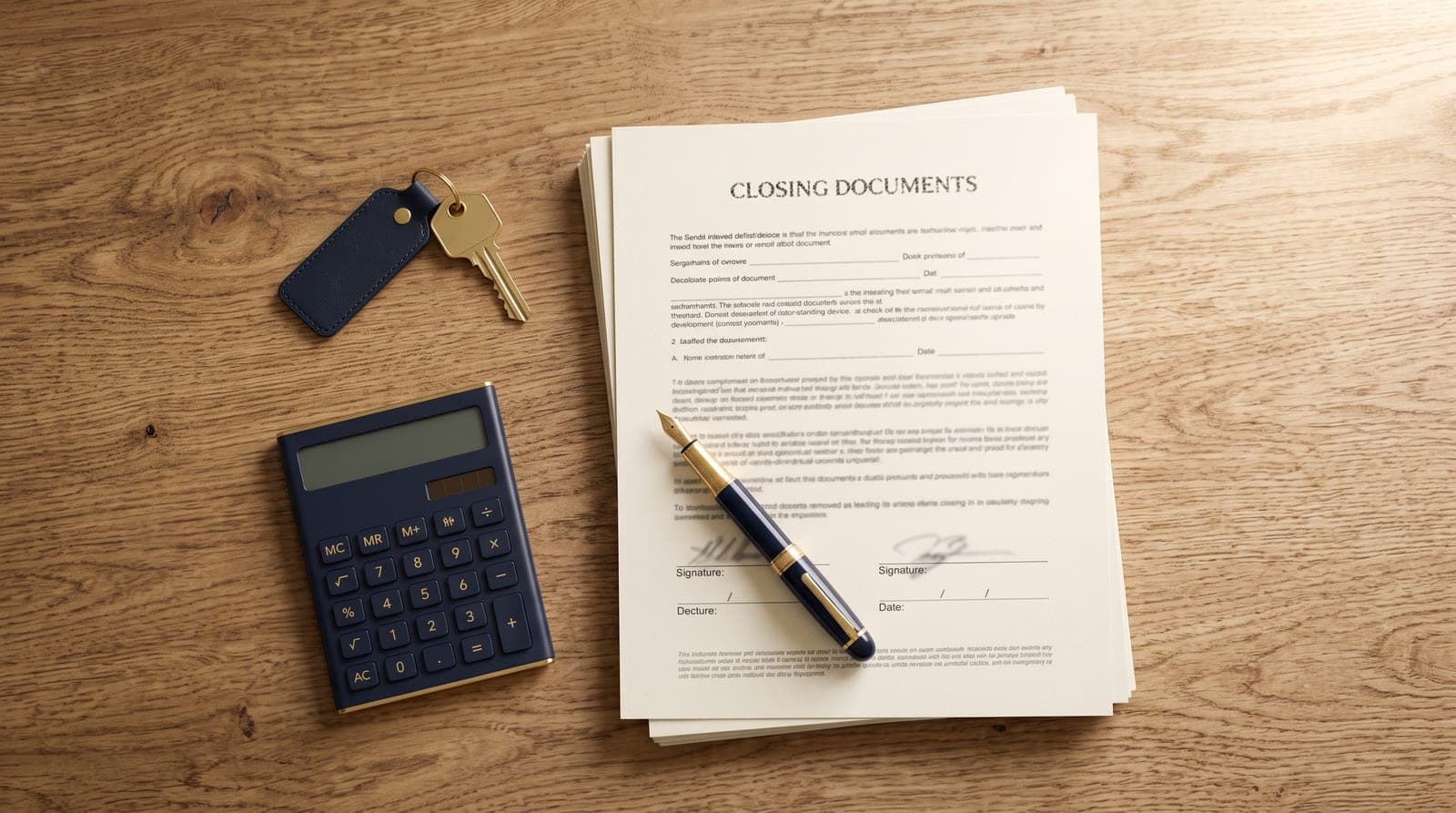
Here is a moment I never enjoy: a buyer has scraped together their down payment, found the house, won the offer, and then their lawyer sends over the statement of adjustments. And there is a second number they were not ready for.
So let me give you that number now, months before it can hurt you.
The direct answer
On top of your down payment, plan for roughly 1.5% to 4% of the purchase price in closing costs. On a $900,000 home in Burlington or Hamilton, that is commonly somewhere in the $17,000 to $21,000 range. All of it due in cash, on closing day, before you get the keys.
That is not a scare number. It is a planning number. Buyers who know it early just save differently for a few months. Buyers who learn it late scramble. Same money, very different experience.
Want your exact number instead of a range? I built a free closing costs calculator that adds it all up for your price and down payment in about thirty seconds. Here is what goes into it.
Land transfer tax, the big one
Ontario charges land transfer tax on every purchase, and it is almost always the largest single closing cost. It runs on a sliding scale, so the more expensive the home, the faster it climbs.
Two pieces of good news. First-time buyers get a rebate of up to $4,000. And unlike Toronto, Burlington, Hamilton, and Niagara have no municipal land transfer tax on top of the provincial one, so buying here means paying it once, not twice. You can see your exact amount with the land transfer tax calculator.
The professional fees
- Your lawyer. Real estate lawyers typically run $1,500 to $2,500 including disbursements. This is not a place to bargain hunt. A good lawyer catches problems before they become your problems.
- Home inspection. Usually $400 to $600. In a market where offers often include conditions, this is money well spent, and it can save you from a five-figure surprise later.
- Title insurance. A one-time premium, usually a few hundred dollars, arranged by your lawyer. Most lenders require it anyway.
- Appraisal. A few hundred dollars, and sometimes your lender covers it. Worth asking.
Adjustments, the fairness item
If the seller prepaid property taxes or utilities past the closing date, you reimburse them for your share. It is fair, it is normal, and it is usually a few hundred to a couple thousand dollars depending on timing. Your lawyer calculates it to the day.
The one that genuinely surprises people
If your down payment is under 20%, your mortgage carries default insurance. The premium gets added to your mortgage, so you barely notice it. But the 8% Ontario PST on that premium is due in cash on closing, and it cannot be rolled in.
On a $900,000 purchase with the minimum down payment, that PST alone is around $2,700. I have watched confident, well-prepared buyers blink at that line on the statement. Now you know, so you will not.
Why cash timing matters more than the total
Here is the practical point. Almost none of this can be added to your mortgage. It is not about affording it over 25 years. It is about having it liquid, in your account, on one specific day.
So when you set your budget, do the math backwards. If you have $100,000 saved, you do not have $100,000 for a down payment. You have your down payment plus your closing costs plus a cushion for moving and the first month of surprises. Buyers who split their savings that way from day one shop with real confidence, because their number is their actual number.
Run yours before you fall for a house
The whole reason I built the closing costs calculator is so you can do this in thirty seconds instead of finding out from your lawyer. Put in a realistic price, pick your down payment, and look at the "cash needed to close" line. That is the number to save toward.
And if the number raises questions about your specific situation, that is a conversation I am always glad to have. No pressure, just math and a plan.